


Focus on Hematoma Target Fms-like Tyrosine Kinase 3 (FLT3)
About FLT3
Fms-like tyrosine kinase 3 (FLT3) is also known as CD135 (Cluster of differentiation antigen 135) and FLK2 (Fetal liver kinase-2). It is a member of the type III tyrosine receptor family and is a single transmembrane protein consisting of an extracellular domain (including D1-D5) containing five Ig-like domains, a transmembrane region, a proximal membrane domain (JM) and an intracellular tyrosine kinase domain (TKD). Members of the same family also include PDGFRα, PDGFRβ, M-CSFR, KIT. FLT3 is expressed on lineage-restricted myeloid and lymphoid progenitor cells.
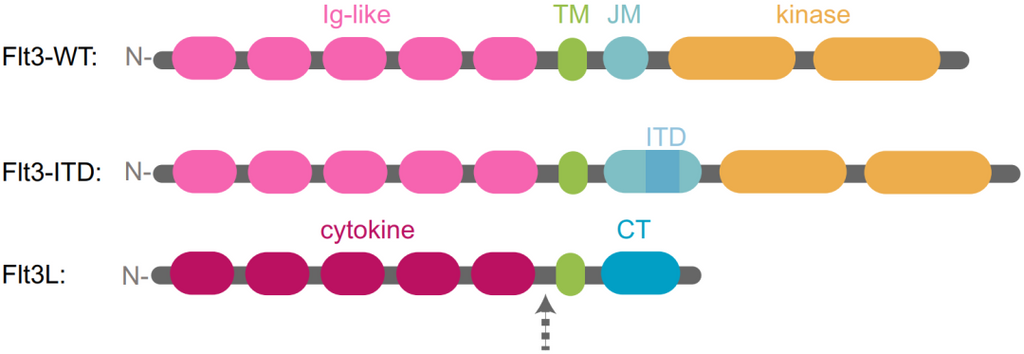

Figure 2: FLT3 binds to FLT3L [2].
FLT3 is activated by binding to its ligand FLT3L, which exists in membrane-bound or soluble form and is produced by bone marrow stromal cells. When FLT3L binds to the D3 domain in FLT3 Ig-like, FLT3 will dimerize, thereby activating downstream signaling pathways, such as PI3K-AKT, JAK-STAT and RAS-MAPK, etc., resulting in the maturation and proliferation of hematopoietic cells. Hence, FLT3 plays an important role in hematological tumor development, particularly in diseases involving abnormal cells in blood or bone marrow.

Figure 3: FLT3-FLT3L signaling pathway [3].
Clinical Impact of FLT3 Mutations
FLT3 mutations are among the most frequently observed genetic alterations in adult acute myeloid leukemia (AML), particularly the FLT3 internal tandem duplication (FLT3-ITD) mutation. These mutations lead to constitutive activation of FLT3 signaling without ligand binding, driving uncontrolled proliferation and survival of leukemic cells through pathways such as PI3K-AKT, RAS-MAPK, and JAK-STAT.
Clinically, FLT3-ITD mutations are associated with aggressive disease behavior, high leukocyte burden, increased relapse risk, and reduced overall survival. Their prognostic significance is especially relevant during AML risk stratification, where FLT3 mutation status may influence treatment planning and response assessment.
Patients with high FLT3-ITD allelic burden often have poorer outcomes than those without FLT3 mutations. In contrast, FLT3 tyrosine kinase domain (TKD) mutations may demonstrate more variable prognostic effects depending on co-occurring genetic alterations and treatment strategy.
FLT3 mutations can also contribute to treatment resistance and disease recurrence. In some cases, AML cells develop secondary resistance mutations after exposure to FLT3 inhibitors, limiting long-term therapeutic efficacy. This has driven continued interest in combination therapies involving FLT3 inhibitors, monoclonal antibodies, CAR-T approaches, and other targeted modalities.
Because FLT3 mutation status strongly influences disease progression and therapeutic response, FLT3 testing has become an integral part of AML molecular profiling. This analysis commonly evaluates FLT3 alongside other AML-associated genes to support patient stratification, therapy selection, and research into resistance mechanisms.
FLT3 Targeting Drugs
Small Molecule Inhibitors
FLT3 small-molecule inhibitors have been studied for more than two decades, either inhibiting the ATP-binding pocket in the tyrosine-kinase domain, or inhibiting the inactive conformational epitopes adjacent to the ATP pocket. They can also be used as allosteric regulators. Representative drugs are Gilteritinib, Crenolanib, and FF10101.
However, small-molecule compounds have their own limitations, such as low specificity leading to off-target toxicity and single efficacy leading to drug resistance. AML patients treated with FLT3 inhibitors have poor survival within five years.
In clinical practice, FLT3 inhibitors may be evaluated in combination with chemotherapy, including during induction therapy, depending on patient status, mutation profile, and treatment setting.
PROTAC
PROTAC is a technology that integrates the advantages of small molecule compounds and can cause the degradation of target proteins. It has been reported that the research team at Nankai University has developed a highly efficient PROTAC drug targeting the first-generation FLT3-ITD inhibitor Dovitinib, which shows greater killing ability against FLT3-ITD-positive AML cells than Dovitinib alone [4]. This methodology reflects growing interest in targeted degradation as an alternative to kinase inhibition alone.
Antibody Drugs
Monoclonal antibodies targeting FLT3 include IMC-EB10, IMC-NC7, etc., can block the interaction between FL and FLT3 and inhibit the phosphorylation and activation of FLT3. However, monoclonal antibodies alone may not be effective. IMC-EB10 was terminated because the maximum tolerated dose did not reach therapeutic significance. There are other antibody drugs with improved efficacy, specificity, and in vivo kinetics though. These include 4G8SDIEM with optimized Fc segment, FLT3-A192 with protein-peptide coupling, and the double antibody 7370 Anti-FLT3-CD3 that targets both CD3 and FLT3.

Figure 4: 7370 Anti-FLT3-CD3 double antibody targets D4 of FLT3 [5].
T-Cell Therapy
T-cell therapy is a major direction of FLT3 targeted therapy. Autologous T-cell therapy for FLT3-ITD mutant CAR-T cells has been reported to be more effective when combined with FLT3 inhibitors [6],[7]. There is also a dual-target CAR-T developed on this basis. It simultaneously targets FLT3 and the FLT3-ITD-related WT-1 antigen to prevent disease recurrence due to treatment escape. There is also the introduction of cytokines, such as IL-12, into CAR to further improve the efficacy (i.e. AMG 553 in clinical phase I). TCR-T is another strategy. By changing the complementarity-determining region of the TCR that binds the neoantigen peptide, the TCR can achieve higher affinity. Also, the TCR can be transformed into a human-mouse chimera to enhance the stability of the TCR-CD3 complex [8].
There are also recombinant truncated FLT3 ligands and Fc fusion protein drugs developed by Innovent Biologics, which have shown good anti-tumor effects in vivo, and can further exert synergistic effects in combination with PD-1 antibodies. Moreover, small molecular compounds can interfere with the transcription, translation and degradation of FLT3. Finally, compounds such as OTS514 and HSD1169 can inhibit FLT3-related signaling pathways.
Advancements in FLT3-Targeted Therapy
New research focuses on novel agents to address resistance and on using FLT3 inhibitors as maintenance therapy after stem cell transplantation. Researchers are developing next-generation FLT3 inhibitors with improved selectivity and resistance profiles, alongside combination approaches designed to improve response durability in AML.
Dual-target strategies are also gaining attention. These include bispecific antibodies targeting FLT3 and immune-related antigens such as CD3, as well as CAR-T platforms engineered to recognize multiple leukemia-associated targets simultaneously. Such approaches may help reduce treatment escape and improve anti-leukemic activity.
In parallel, protein engineering and targeted degradation technologies are contributing to more precise therapeutic modulation. PROTAC-based degraders, Fc-optimized antibodies, and cytokine-enhanced immune cell therapies continue to progress through preclinical and early clinical development. Researchers are also exploring biomarker-guided treatment strategies to better match FLT3-targeted therapies with specific mutation profiles and disease states.
Together, these developments reflect continued progress toward more selective, durable, and clinically effective FLT3-directed therapies.
KACTUS provides high-quality FLT3 recombinant protein
FLT3 is a mature target for various types of drugs in singular or in combination, thus leaving broad potential for drug development. KACTUS has always paid attention to the field of hematological tumor treatment. With the help of our unique protein expression platform SAMS™, we have successfully developed high-quality recombinant FLT3 and FLT3L proteins of various species and labels, which can be applied to drug discovery, screening, and evaluation. Our quality control standards make them suitable for preclinical CMC research to support the development of relevant drugs. These protein interactions are further validated using techniques such as SPR assay to determine binding kinetics with high sensitivity.
Example Product Data

Figure 5. Immobilized Human FLT3 Ligand, His Tag at 1μg/mL (100μL/Well) on the plate. Dose response curve for Human FLT3, hFc Tag with the EC50 of 30ng/mL determined by ELISA.

Figure 6. Mouse FLT3 Ligand, hFc Tag captured on CM5 Chip via Protein A can bind Human FLT3, His Tag with an affinity constant of 13.81 nM as determined in SPR assay (Biacore T200).

Figure 7. Human FLT3 Ligand, hFc Tag immobilized on CM5 Chip can bind Mouse FLT3, hFc Tag with an affinity constant of 35.07 nM as determined in SPR assay (Biacore T200).
KACTUS Products
|
|
Mouse FLT3 Ligand, His Tag |
FAQs
1. Why is FLT3 a major target in AML research?
FLT3 is frequently altered in adult acute myeloid leukemia, especially through FLT3-ITD mutations. These mutations can drive abnormal proliferation of leukemic cells in the blood or bone marrow, making FLT3 a key target in AML drug discovery and molecular profiling.
2. How does FLT3 mutation status affect prognosis?
FLT3-ITD mutations have strong prognostic significance because they are associated with aggressive disease, increased relapse risk, and reduced overall survival. AML testing often includes FLT3 mutation analysis alongside other genes to support risk assessment and treatment planning.
3. How are FLT3 inhibitors used in AML treatment research?
FLT3 inhibitors are studied as targeted therapies and may be used with chemotherapy, including during induction therapy. Research continues to evaluate how FLT3 inhibitors perform in different AML mutation profiles and combination settings.
4. What makes recombinant FLT3 and FLT3L proteins useful for buyers?
Recombinant FLT3 and FLT3L proteins support antibody screening, binding studies, inhibitor evaluation, and assay development. For research teams in hematology and oncology, validated proteins help reduce setup time and improve confidence in early-stage screening data.
5. What should buyers consider when selecting FLT3 recombinant proteins?
Buyers should assess species, tag format, purity, activity validation, and assay compatibility. SPR-validated binding data and reliable QC documentation are especially useful when the protein is intended for drug discovery, preclinical CMC research, or translational AML studies.
References
[1] Wilson KR, Villadangos JA, Mintern JD. Dendritic cell Flt3 - regulation, roles and repercussions for immunotherapy. Immunol Cell Biol. 2021 Oct;99(9):962-971. doi: 10.1111/imcb.12484. Epub 2021 Jul 2. PMID: 34097779.
[2] Roskoski R Jr. The role of small molecule Flt3 receptor protein-tyrosine kinase inhibitors in the treatment of Flt3-positive acute myelogenous leukemias. Pharmacol Res. 2020 May;155:104725. doi: 10.1016/j.phrs.2020.104725. Epub 2020 Feb 25. PMID: 32109580.
[3] Acharya B, Saha D, Armstrong D, Lakkaniga NR, Frett B. FLT3 inhibitors for acute myeloid leukemia: successes, defeats, and emerging paradigms. RSC Med Chem. 2022 May 23;13(7):798-816. doi: 10.1039/d2md00067a. PMID: 35923716; PMCID: PMC9298189.
[4] Cao S, Ma L, Liu Y, Wei M, Yao Y, Li C, Wang R, Liu N, Dong Z, Li X, Li M, Wang X, Yang C, Yang G. Proteolysis-Targeting Chimera (PROTAC) Modification of Dovitinib Enhances the Antiproliferative Effect against FLT3-ITD-Positive Acute Myeloid Leukemia Cells. J Med Chem. 2021 Nov 25;64(22):16497-16511. doi: 10.1021/acs.jmedchem.1c00996. Epub 2021 Oct 25. PMID: 34694800.
[5] Yeung YA, Krishnamoorthy V, Dettling D, Sommer C, Poulsen K, Ni I, Pham A, Chen W, Liao-Chan S, Lindquist K, Chin SM, Chunyk AG, Hu W, Sasu B, Chaparro-Riggers J, Djuretic I. An Optimized Full-Length FLT3/CD3 Bispecific Antibody Demonstrates Potent Anti-leukemia Activity and Reversible Hematological Toxicity. Mol Ther. 2020 Mar 4;28(3):889-900. doi: 10.1016/j.ymthe.2019.12.014. Epub 2020 Jan 14. PMID: 31981494; PMCID: PMC7054815.
[6] Jetani H, Garcia-Cadenas I, Nerreter T, Thomas S, Rydzek J, Meijide JB, Bonig H, Herr W, Sierra J, Einsele H, Hudecek M. CAR T-cells targeting FLT3 have potent activity against FLT3-ITD+ AML and act synergistically with the FLT3-inhibitor crenolanib. Leukemia. 2018 May;32(5):1168-1179. doi: 10.1038/s41375-018-0009-0. Epub 2018 Feb 5. PMID: 29472720.
[7] Li KX, Wu HY, Pan WY, Guo MQ, Qiu DZ, He YJ, Li YH, Yang DH, Huang YX. A novel approach for relapsed/refractory FLT3mut+ acute myeloid leukaemia: synergistic effect of the combination of bispecific FLT3scFv/NKG2D-CAR T cells and gilteritinib. Mol Cancer. 2022 Mar 4;21(1):66. doi: 10.1186/s12943-022-01541-9. Erratum in: Mol Cancer. 2022 Jun 23;21(1):134. PMID: 35246156; PMCID: PMC8896098.
[8] Cohen CJ, Zhao Y, Zheng Z, Rosenberg SA, Morgan RA. Enhanced antitumor activity of murine-human hybrid T-cell receptor (TCR) in human lymphocytes is associated with improved pairing and TCR/CD3 stability. Cancer Res. 2006 Sep 1;66(17):8878-86. doi: 10.1158/0008-5472.CAN-06-1450. PMID: 16951205; PMCID: PMC2147082.
