



GDF15-GFRAL breaks into the new drug track
By Mallory Griffin
July 12, 2022
Featured Products




A variety of metabolic diseases that affect global health, such as obesity, diabetes, cancer, and other health and metabolic disease areas, have yet to be solved. Several studies have confirmed that the GDF15-GFRAL pathway is involved in regulating the body's metabolism, inflammation, and immune response, energy balance, and appetite. This suggests that GDF15-GFRAL could be a therapeutic target for related diseases.
GDF15
GDF15 (Growth Differentiation Factor 15) belongs to the TGFβ (Transforming growth factor β) superfamily and is often described as a divergent member of this protein family. The two proteins of GDF15 first form a dimer structure through a disulfide bond, which is then hydrolyzed at the RXXR site to form the mature form of GDF15. This form is then secreted outside the cell. In some cells, the precursor dimer can also be secreted separately and attach to the extracellular matrix until cleaved (Figure 1).
GDF15 is an endocrine hormone mainly involved in cell growth, differentiation, and tissue repair. Under normal physiological conditions, GDF15 is highly expressed in the prostate and placenta and weakly expressed in most tissues, including the heart. However, it can be up-regulated under external stressors (such as hypoxia, mitochondrial damage, metformin, and endurance exercise) (Figure 1). This feature gives GDF15 important auxiliary diagnosis or treatment value in myocardial infarction, stroke, and acute coronary syndrome, and selected central nervous system disease contexts.
GDF15, first discovered in 1997 [1], acts as an autoregulatory factor in macrophages that inhibits lipopolysaccharide-induced tumor necrosis factor-alpha (TNFα) release. Due to its discovery by different researchers, GDF15 has been given different names: TGF-PL, MIC-1 (Macrophage Inhibitory Cytokine-1), PDF (Prostate-derived factor), PLAB (Placental bone morphogenetic protein), NAG-1 ( Non-steroidal anti-inflammatory drug-inducible gene), PTGFB (Placental transforming growth factor-beta).

Figure 1. Synthesis mechanism of GDF15 (dotted line means unknown mechanism) [2].
Features of GDF15
GDF15 acts by binding to its receptor GFRAL (glial cell line-derived neurotrophic factor-family receptor α-like). GFRAL was identified in 2017 to as a receptor that binds GDF15 and activates the "emergency pathway" involved in regulating body weight under unsteady conditions [3]. GFRAL, a transmembrane protein expressed only in the hindbrain, requires the help of the accessory protein RET for signaling. When GDF15 binds to GFRAL, RET will autophosphorylate and lead to the activation of downstream signaling pathways such as PI3K-AKT and PLC-PKC, thereby regulating many physiological processes, including affecting food intake, energy expenditure, and weight loss (this is more pronounced in the presence of metformin) (Figure 2). GDF15 is also called the "anorexia hormone" [4] because of its effect on appetite.
As an immune checkpoint, GDF15 can inhibit the maturation of dendritic cells, hinder the activation of cytotoxic T lymphocytes, and promote the immune escape of tumor cells. In addition, GDF15-GFRAL plays an important role in non-alcoholic fatty liver disease, cardiovascular disease, and other diseases.

Figure 2. GDF15 mediates the transmission of the signaling pathway by binding GFRAL-RET [5].
GDF15 Related Drugs
The GDF15-GFRAL-mediated signaling pathway is a natural stress response mechanism in the human body and is implicated in the progression of many commonly studied diseases. The diverse functions of GDF15 offer various potential therapeutic applications aimed at reducing adiposity in obesity and improving insulin sensitivity in diabetes.
It can affect food intake to control obesity and as an immune checkpoint, it can be used for the treatment of solid tumors and advanced cancer. There are no GDF15-related drugs on the market, but many have entered clinical trials, focusing on GDF15 analogs and GFRAL agonists as well as their monoclonal antibodies. The main idea is to either activate the GDF15-GFRAL signaling pathway to control food intake and thereby inhibit the development of metabolic diseases, or to inhibit this pathway to enhance the immune system's attack on solid tumors while reducing the cancer cachexia syndrome caused by GDF15-GFRAL.
Cachexia is characterized by involuntary weight loss, primarily from muscle mass, and is a significant problem for many cancer patients, leading to reduced quality of life and poorer outcomes
This condition can involve loss of muscle, reduced fat mass, reduced appetite, and altered metabolism. GDF15 levels can rise by as much as 10–100-fold in advanced cancer, leading to anorexia-cachexia syndrome, which is often fatal.
Notably, injection of exogenous GDF15 may induce anorexia and spontaneous motility, which may counteract the positive effects of targeting GDF15 in the treatment of metabolic diseases. Some studies have found that elevated levels of GDF15 may exert a tumor suppressor effect in the early stage of the tumor, but becomes a tumor-promoting agent in the later stage [6]. Therefore, the relevant mechanism needs to be clarified in order to balance safety and efficacy.
In addition, existing research shows that the development of monoclonal antibodies for GFRAL may be superior to GDF15, because GDF15 is more sensitive to cellular stress response, and may require higher concentrations of monoclonal antibodies to be neutralized. GFRAL, on the other hand, is tissue-restricted, so a low-level monoclonal antibody against it can still achieve a therapeutic effect. The following are GDF15 and GFRAL drugs entering clinical trials:
|
Drug Name |
Target |
Drug Type |
Disease |
Company |
Clinical Stage |
|
Visugromab (CTL-002) |
GDF15 |
Monoclonal Antibody |
Solid tumor |
CatalYm |
Phase II |
|
Ponsegromab (PF-06946860) |
GDF15 |
Monoclonal Antibody |
Cachexia, Heart failure |
Pfizer |
Phase I |
|
AV-380 |
GDF15 |
Monoclonal Antibody |
Cachexia |
AVEO |
Phase I |
|
AZD-8853 |
GDF15 |
Monoclonal Antibody |
Solid tumor |
AstraZeneca |
Phase I |
|
/ |
GDF15 |
Agonist |
Diabetes |
Eli Lilly |
Phase I |
|
NN-9215 |
GDF15 |
Analog |
Obesity |
Novo Nordisk |
Phase I |
|
NGM-120 |
GFRAL |
Monoclonal Antibody |
Cachexia |
NGM Bio |
Phase I |
|
CIN 109 (JNJ-9090) |
GFRAL |
Agonist |
Obesity |
Johnson & Johnson |
Phase I |
Among them, NGM-120 has entered clinical phase II for solid tumors and pancreatic cancer, another indication for the drug. This is one of the four clinical phase II drugs of NGM Bio. At present, domestic companies entering the GDF15-GFRAL target have shown an upward trend, and it is believed that promising drugs will come out in the future to benefit patients.
KACTUS has a self-developed prokaryotic expression system and a recombinant GDF15 protein expressed by a eukaryotic expression system, which overcomes the low solubility of GDF15 expressed in a prokaryotic expression system. It also provides various types of GFRAL proteins. Multiple species and tags are available for both proteins and all have been verified by activity testing. They have high biological activity and stability and can be used in the development of GDF15-GFRAL-related drugs.
Product Data

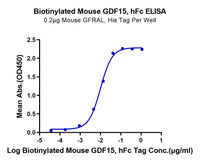
Immobilized Human GDF15, His Tag at 0.5μg/ml (100μl/well) on the plate. Dose-response curve for Human GFRAL, hFc Tag with an EC50 of 22.8ng/ml determined by ELISA.

Immobilized Human GDF15, mouse IgG2a Fc Tag at 0.5μg/ml (100μl/well) on the plate. Dose-response curve for Anti-GDF15 Antibody, hFc Tag with an EC50 of 6.0ng/ml determined by ELISA.

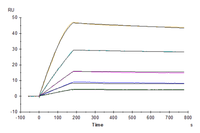
Serial dilutions of Anti-GDF15 Antibody were added into Human GDF15, His Tag: Biotinylated Human GFRAL, His Tag binding reactions. The IC50 is 40.8ng/ml.
KACTUS Product List
|
Catalog # |
Description |
|
Human GDF15, His Tag |
|
|
Biotinylated Human GDF15, His-Avi Tag |
|
|
Human GDF15, hFc Tag |
|
|
Biotinylated Human GDF15 Protein |
|
|
GDF-ME115 |
Mouse GDF15, His Tag |
|
Mouse GDF15, hFc Tag |
|
|
Biotinylated Mouse GDF15 Protein |
|
|
Cynomolgus GDF15, His Tag |
|
|
Cynomolgus GDF15, hFc Tag |
|
|
Biotinylated Cynomolgus GDF15 Protein |
|
|
Human GFRAL, His-Avi Tag |
|
|
Biotinylated Human GFRAL, His-Avi Tag |
|
|
Human GFRAL, hFc Tag |
|
|
Mouse GFRAL, His-Avi Tag |
|
|
Biotinylated Mouse GFRAL, His-Avi Tag |
|
|
Cynomolgus GFRAL, His-Avi Tag |
|
|
Biotinylated Cynomolgus GFRAL, His-Avi Tag |
FAQs
1. What is the GDF15-GFRAL pathway and why is it being studied?
The GDF15-GFRAL pathway is a stress-response signaling pathway involved in appetite regulation, metabolism, inflammation, and immune response. It is being studied because it may affect energy balance, energy expenditure, cachexia, obesity, and tumor immune escape.
2. How is GDF15 linked to obesity and metabolic disease?
GDF15 can reduce food intake by acting through GFRAL in the hindbrain. This makes the pathway relevant to obesity, weight gain, altered fat mass, and broader health and metabolic disease research.
3. Why are GDF15 levels important in advanced cancer?
In advanced cancer, GDF15 may become highly elevated and contribute to anorexia-cachexia syndrome. This syndrome is associated with loss of muscle mass, reduced appetite, poor quality of life, and worse clinical outcomes.
4. Why might GFRAL be a better drug target than GDF15?
GFRAL is mainly expressed in the hindbrain, while GDF15 responds broadly to cellular stress. This tissue-restricted receptor pattern suggests that GFRAL-targeted antibodies may achieve therapeutic effects through more controlled pathway modulation.
5. How can KACTUS GDF15 and GFRAL proteins support drug discovery?
KACTUS provides activity-verified GDF15 and GFRAL proteins in multiple species and tag formats. These proteins can support antibody screening, functional studies, binding analysis, and early research into drugs for metabolic disease, cachexia, and cancer-related applications.
References
[1] Bootcov MR, Bauskin AR, Valenzuela SM, Moore AG, Bansal M, He XY, Zhang HP, Donnellan M, Mahler S, Pryor K, Walsh BJ, Nicholson RC, Fairlie WD, Por SB, Robbins JM, Breit SN. MIC-1, a novel macrophage inhibitory cytokine, is a divergent member of the TGF-beta superfamily. Proc Natl Acad Sci U S A. 1997 Oct 14;94(21):11514-9.
[2] Wang D, Day EA, Townsend LK, Djordjevic D, Jørgensen SB, Steinberg GR. GDF15: emerging biology and therapeutic applications for obesity and cardiometabolic disease. Nat Rev Endocrinol. 2021 Oct;17(10):592-607.
[3] Hsu JY, Crawley S, Chen M, Ayupova DA, Lindhout DA, Higbee J, Kutach A, Joo W, Gao Z, Fu D, To C, Mondal K, Li B, Kekatpure A, Wang M, Laird T, Horner G, Chan J, McEntee M, Lopez M, Lakshminarasimhan D, White A, Wang SP, Yao J, Yie J, Matern H, Solloway M, Haldankar R, Parsons T, Tang J, Shen WD, Alice Chen Y, Tian H, Allan BB. Non-homeostatic body weight regulation through a brainstem-restricted receptor for GDF15. Nature. 2017 Oct 12;550(7675):255-259.
[4] Coll AP, Chen M, Taskar P, Rimmington D, Patel S, Tadross JA, Cimino I, Yang M, Welsh P, Virtue S, Goldspink DA, Miedzybrodzka EL, Konopka AR, Esponda RR, Huang JT, Tung YCL, Rodriguez-Cuenca S, Tomaz RA, Harding HP, Melvin A, Yeo GSH, Preiss D, Vidal-Puig A, Vallier L, Nair KS, Wareham NJ, Ron D, Gribble FM, Reimann F, Sattar N, Savage DB, Allan BB, O'Rahilly S. GDF15 mediates the effects of metformin on body weight and energy balance. Nature. 2020 Feb;578(7795):444-448.
[5] Mullican SE, Lin-Schmidt X, Chin CN, Chavez JA, Furman JL, Armstrong AA, Beck SC, South VJ, Dinh TQ, Cash-Mason TD, Cavanaugh CR, Nelson S, Huang C, Hunter MJ, Rangwala SM. GFRAL is the receptor for GDF15 and the ligand promotes weight loss in mice and nonhuman primates. Nat Med. 2017 Oct;23(10):1150-1157.
[6] Breit SN, Brown DA, Tsai VW. The GDF15-GFRAL Pathway in Health and Metabolic Disease: Friend or Foe? Annu Rev Physiol. 2021 Feb 10;83:127-151.

60 Hickory Drive
Waltham, MA 02451
United States